
 By
By The question we get asked the most is “What is the right budget to put into Meta ads? Five hundred a month? Two thousand? Whatever is left over after payroll?”
Here is the honest answer. There is no one-size-fits-all. A budget for a Countertops company can be very different from a Flooring company. To come up with the right budget, you need to think about what a job is actually worth to you. This post walks through lead costs, the realistic starting ranges, and the one thing that quietly wastes more ad budget than any targeting mistake.
Budget planning tip: Your ideal marketing budget depends on your location, competition, average project value, close rate, and growth goals. These figures are general starting points, not guaranteed performance estimates.
First, A Reality Check On What A Lead Costs
Before you set a budget, you need to know what you are buying. Unlike search-based advertising (Google Ads), where you pay per click and costs can skyrocket quickly, in Meta you pay for the impressions to show your ad to a specific group of people in a specific place. On Facebook and Instagram, which both run through Meta, home improvement companies like Countertops, Kitchen & Bath and Cabinets are paying somewhere in the range of $30 to $50 for each lead that comes through, while remodeling and construction companies like Flooring and Tile & Stone are trending toward the higher end of that this year. The platform-wide average across all industries sits around $28, but home improvement runs above that because the work is high value and the competition for a homeowner’s attention is fierce.
That sounds expensive until you put it next to the alternative. The same lead on Google Ads averages closer to $70. A homeowner scrolling Facebook on the couch is cheaper to reach than one actively searching Google, which is exactly why Meta should be a line on the payroll for most home improvement companies.
So if a lead costs you around $40, a $1,000 monthly budget buys you roughly 25 leads. The question that matters is no longer whether $1,000 is enough. It is what happens after those 25 leads come in, and how many of them turn into actual signed jobs.
The Starting Range Most Home Improvement Companies Should Plan For
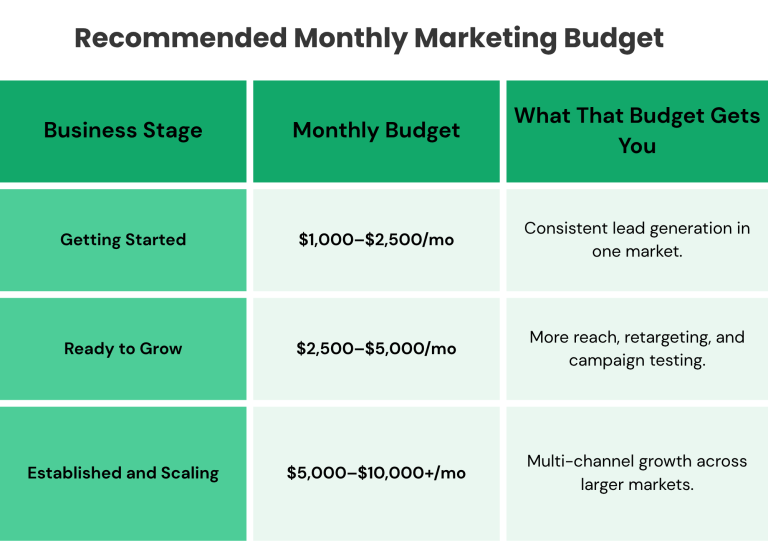
If you want a real number to anchor on: most home improvement companies should start somewhere between $1,000 and $2,500 a month in ad spend, not counting whatever you pay someone to manage the campaign. This budget can support a consistent campaign and generate around 15 to 30 leads per month.
The reason why the starting floor is closer to a thousand dollars is that Meta’s system needs a minimum volume of results before it can figure out who to show your ads to. If your budget is too small, it never gets enough data to optimize, so your cost per lead stays high and your money disappears without your campaign ever finding its footing. A budget that is too small does not fail gently. It fails completely. You are better off running a focused $1,000 campaign in one service area than spreading $400 across the whole county.
The maximum amount of budget depends on your capacity. If your crew can comfortably take on eight new kitchen jobs a month and you are already booked through next quarter, pouring $5,000 into ads just buys you leads you cannot service, and bad reviews.
Your budget should track what your business can actually handle, then grow as you add capacity. This budget is a good starting point for any company. Once you feel comfortable with the number of leads received and you grow your business, that budget should grow with you.
The Mistake That Wastes More Money Than Your Budget Ever Will
Here is the part nobody running a campaign wants to hear. The biggest leak in home improvement advertising is not the budget. It is what happens after the lead comes in.
You can run a flawless campaign at a perfect cost per lead and still lose money, because a lead that sits in an inbox for two days is worth a fraction of one you call in five minutes. The data on this is consistent and brutal. Reaching out within the first five minutes dramatically improves whether a lead ever becomes a job or not. A homeowner who fills out a form on Facebook is often filling out three others the same evening. The company that calls first usually wins, and it is frequently not the company with the best work or the lowest price. It is just the one that showed up first.
This is where most home improvement companies quietly bleed budget. They pay $40 for a lead, then let it go cold while a job runs long and nobody checks the new leads coming in. The ad worked. The follow-up did not. And now the job is gone either way.
So before you raise your budget, make sure every lead you already pay for actually gets worked on. That usually does more for your return than any amount of extra spend.
Where To Go From Here
A good Meta ads budget for a home improvement company is not a magic number. It is a calculation based on how many jobs your company can handle. Start in the $1,000 to $2,500 range, tie it to the work your crew can handle, and never spend a dollar chasing new leads until you are certain the ones you already have are being followed up on fast.
That last part is the whole game, and it is exactly what Project Perks is built to handle. Every lead from your Meta ads lands in one pipeline the moment it is submitted, scored hot, warm, or cold, with an out-of-area filter so you are not chasing jobs three hours away. Each morning you get a simple digest of who came in and who to call first, so no $40 lead ever goes cold in an inbox again. And if you are not running Meta ads yet, our team can build and launch your first campaign with you on a single call, live on the same day.